On the gutting of the American middle class, the absence of worker protections, and why the logistics industry is repeating history and making the same mistake while the courts look the other way.
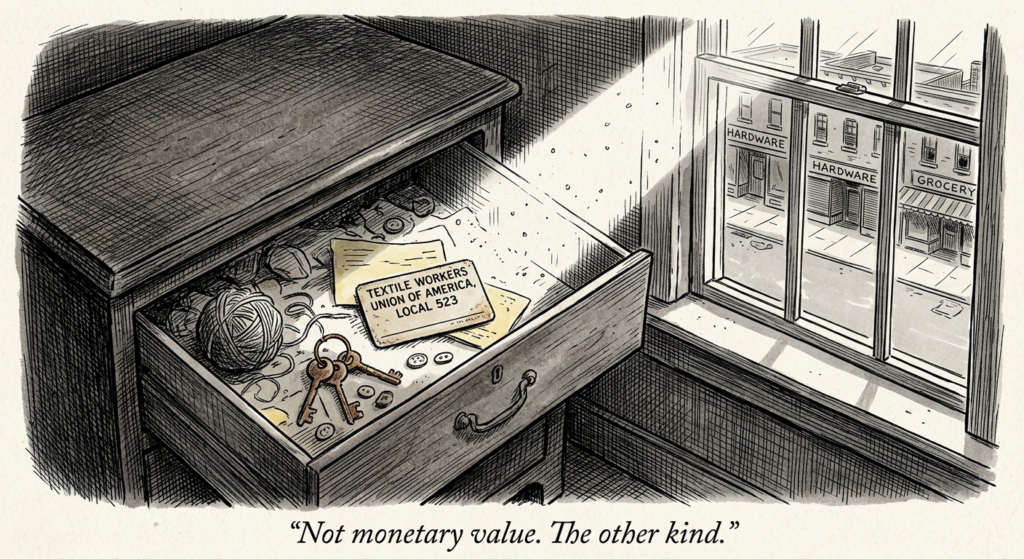
In Adams, Massachusetts, in the northwest corner of the Berkshires where the Hoosac Range catches the weather and the Hoosic River runs south through town, there used to be a mill called Arnold Print Works. It printed calico and cotton and employed most of the people who lived within walking distance of its smokestacks. My grandfather worked there. My grandfather carried a union card, Textile Workers Union of America, Local 523. The mill closed. Then the next one closed. Then the town got quiet and never got loud again.
Nobody called it a restructuring. Nobody called it a synergy. Nobody stood at a podium and said the closure was a tech-enabled efficiency or a baseline reset or a productivity story. The mills closed because the work moved somewhere else, somewhere the labor was cheaper, and the people who had spent their lives inside those buildings were told, in the particular silence that accompanies institutional abandonment, that the distance between their skill and their paycheck had been recalculated by someone who would never visit their town.
That was the 1980s. It was the beginning of something that would take thirty years to finish, and when it was finished, the American middle class, the thing that had been the defining feature of the American economy since the end of the Second World War, was hollowed from the inside like a tree that looks solid until the wind comes.
Let me show you the numbers, because the numbers are the story the speeches were designed to obscure.
In 1971, 61 percent of American adults lived in middle-income households. That was the country. Not the country’s aspiration or its marketing or its self-image. That was the measurable, empirical reality of the United States of America: six out of every ten adults lived in the middle. The middle-income share of aggregate household income was 62 percent. The people in the middle earned most of the money, and the economy was shaped, built, and governed for their benefit. Not perfectly. Not justly. Not equally across race or gender or geography. But structurally, the American economy was a middle-class economy, and the middle class knew it, and the politicians knew it, and the factory floor and the kitchen table were connected by a thread called stability.
By 2023, the share of Americans living in middle-income households had fallen to 51 percent. Ten percentage points. Ten percent of the American population had slid out of the middle, and while some moved up, more moved down. The share in lower-income households rose from 27 percent to 30 percent. The share in upper-income households rose from 11 percent to 19 percent. The country was pulling apart at both ends, the way a fabric tears when the weave loosens in the center. And the middle-class share of aggregate income had plunged from 62 percent in 1970 to 43 percent by 2022. The middle class shrank and what it earned shrank faster. The median income of middle-class households rose 60 percent over fifty years, which sounds like progress until you learn that the median income of upper-income households rose 78 percent over the same period. The people at the top pulled away. The people in the middle fell behind. And the gap, measured in dollars, measured in opportunity, measured in the particular anxiety that settles over a household when the math stops working, widened every decade, without exception, for half a century.
That is not a recession. A recession ends. That is a structural transfer, administered in slow motion, narrated in the language of progress, and paid for by the people who could least afford the bill.
The transfer had a midwife. His name was Bill Clinton, and I am not saying this to make a partisan point, because the policy architecture he championed was bipartisan in its construction and bipartisan in its damage. Clinton signed NAFTA into law on December 8, 1993. The agreement had been negotiated under George H.W. Bush, but Clinton championed it, fought for it, sold it to his own party with the promise that open markets would lift all boats. He stood in the Rose Garden with former presidents from both parties and said this was the future. On January 1, 1994, the agreement took effect. Between 1993 and 2000, the U.S. trade deficit with the NAFTA countries expanded from $9.1 billion to roughly $32 billion. The Economic Policy Institute estimated that NAFTA cost the United States 766,030 jobs between 1993 and 2000, with 72 percent of them, roughly 545,000, in manufacturing.
Then came China. Clinton pushed aggressively for China’s admission to the World Trade Organization and for permanent normal trade relations, which he signed into law on October 10, 2000. China acceded to the WTO on December 11, 2001. The president told the country that the deal would create a win-win result for both nations. He said exports to China supported hundreds of thousands of American jobs and that those numbers would grow substantially with the new market access. The administration’s own economists projected a shrinking trade deficit with China. The opposite happened. The U.S. goods trade deficit with China exploded from $83 billion in 2001 to $420 billion in 2018. The Economic Policy Institute estimated that the growth of the U.S. trade deficit with China between 2001 and 2018 was responsible for the loss of 3.7 million American jobs, three-quarters of which, roughly 2.8 million, were in manufacturing.
U.S. manufacturing employment had peaked in June 1979 at 19.6 million. It held roughly steady, with cyclical dips and recoveries, through the 1990s. Then, after China’s WTO entry, it fell off a cliff. By early 2010, manufacturing employment had bottomed at fewer than 11.5 million. In thirty years, the country lost roughly 6.7 million manufacturing jobs, and the steepest losses came in the decade immediately following the trade deals Clinton had promised would create prosperity.
And here is where the story becomes not merely sad but criminal in its negligence.
The United States had a program designed to help workers displaced by trade. It was called Trade Adjustment Assistance, first established in 1962 under the Kennedy administration. The premise was simple and honest: trade creates winners and losers, and when the government pursues a policy that creates losers, the government has an obligation to help them. TAA offered displaced workers extended unemployment benefits, retraining, and relocation assistance. It was the buffer. It was the thing that was supposed to catch the people the trade deals dropped.
The buffer was a joke.
The training fund was capped at $220 million. When you divided that across the roughly 130,000 workers certified under TAA petitions in a given year, the amount available per worker came to less than $2,000. Less than two thousand dollars. A machinist in Ohio who had spent twenty years building transmissions, whose factory closed because the work moved to Guangzhou, whose skills were specific to an assembly process that no longer existed in his zip code, that man was entitled to less than two thousand dollars in retraining funds. That is not a retraining program. That is an insult formatted as a line item. Workers who completed the retraining programs and found new employment earned, on average, roughly 30 percent less than they had in their previous jobs. The relocation allowance covered 90 percent of allowable moving costs up to $1,250, an amount that would not cover the cost of moving a family from one side of Ohio to the other, let alone from a dead mill town to a city where the new economy lived.
The people who wrote the trade deals got everything they wanted. The people who lost their jobs to the trade deals got a voucher that would not pay for a semester at community college and a retraining program that placed them in jobs paying a third less than what they had earned before. The winners won globally. The losers lost locally. And the program designed to bridge the gap was funded at a level that betrayed, in its arithmetic, the government’s actual assessment of what those workers were worth.
But it was not just the money. It was what left the building when the people did.
When a factory closes, the machines go quiet and the building eventually comes down, and that is the visible loss, the one the photographer captures and the politician mentions on the campaign trail. The invisible loss is worse. The invisible loss is the institutional knowledge that walked out the door in lunchboxes and steel-toed boots and the muscle memory of a generation of workers who knew how to do things that cannot be taught in a classroom because they can only be learned by doing them, year after year, mistake after correction, until the knowledge lives in the hands and not in the manual.
A machinist does not learn tolerances from a textbook. A machinist learns tolerances from the sound of the cut, the way the metal curls, the vibration that tells you the tool is wearing before any gauge confirms it. A welder does not learn penetration depth from a diagram. A welder learns it from the color of the arc and the rhythm of the puddle and the particular hiss that separates a good bead from a bead that will crack under load. An engineer does not learn process design from a seminar. An engineer learns process design from the floor, from the decade of watching what breaks and when and why, from the accumulated observation of ten thousand production cycles that produces the quiet authority to say this will work and be right.
That knowledge was not backed up. It was not archived. It was not uploaded to a server or stored in a manual or preserved in any form that survived the closing of the plant. It lived in people, and the people left, and the knowledge left with them, and the pipeline that would have trained the next generation, the apprenticeships, the floor mentorships, the slow transfer of competence from the sixty-year-old to the twenty-five-year-old that is the only mechanism by which industrial skill actually reproduces itself, that pipeline was severed when the factory closed, and it has never been reconnected.
The United States did not just lose millions of manufacturing jobs. It lost the capacity to produce the people who could do those jobs. The training pipeline was not an accessory to the manufacturing base. It was the manufacturing base. The pipeline was the thing that turned a high school graduate from Adams or Flint or any town where the money is short and the ambition is real into a skilled worker who could support a family and own a home and send a kid to college. When the pipeline was cut, the town did not just lose jobs. It lost futures.
And now, thirty years later, the logistics industry is making the same mistake. Every piece of it. The hollowing of the workforce. The absence of protection. The destruction of institutional knowledge. The severing of the training pipeline. All of it, happening again, in real time, while the people at the top collect the savings and the people at the bottom carry the cost.
I have spent the past several months documenting what is happening inside the largest logistics companies on earth: C.H. Robinson, DHL, DSV, Kuehne+Nagel, FedEx, A.P. Moller-Maersk, J.B. Hunt. Each story looked different from the inside. Different founders. Different cultures. Different countries. Different CEOs giving different speeches about different values to different employees while walking them out different doors. But the pattern, when you step back far enough to see it, is identical to the pattern that gutted the manufacturing base between 1993 and 2010.
The trade deals promised prosperity. They delivered dislocation. The AI deployments promise productivity. They are delivering the same thing.
At C.H. Robinson, a company founded in 1905 by a produce broker on the Red River, roughly 5,500 positions have been eliminated over three years, a 31 percent reduction, while the CEO collected approximately $28 million in his first fiscal year and told McKinsey there were no headcount KPIs. At Expeditors, a company whose founder Peter Rose planted a no-layoff culture that survived two recessions and a pandemic, roughly 2,000 employees were covertly terminated in 2023, and then 230 technology workers were laid off in June 2026. At FedEx, the company Fred Smith built with a blackjack hand and a Marine’s conviction that people come first, approximately 42,000 fewer employees exist since 2022, over 475 stations are slated for closure, and the CEO pay ratio stands at 288 to 1. At DSV, 7,000 white-collar positions have already been cut from the Schenker integration, with up to 13,000 targeted overall. At DHL, 8,000 positions are being cut from Post and Parcel Germany while the stock surged 12.3 percent the day of the announcement. At Kuehne+Nagel, over 2,000 positions were eliminated while the company won a Responsible AI award whose stated principle was that AI should augment human potential, not replace it. At J.B. Hunt, over 8,000 employees disappeared in 2023 alone while the company’s blog said it does not lay people off during difficult times. At Maersk, roughly 10,000 positions were eliminated starting in late 2023, and the IT team that saved the company from the NotPetya cyberattack was outsourced to India.
Different suitcases. Same destination.
And the institutional knowledge loss, the thing that nobody in any C-suite is accounting for, is happening again, in the same way, at the same speed, with the same irreversible consequences.
When C.H. Robinson fired 80 of its remaining 150 enterprise sales representatives in a single day, representatives who were meeting or exceeding their sales targets, those people did not disappear from the freight industry. They walked across the street to the competitor with an open requisition, carrying with them twenty years of customer relationships, trade-lane knowledge, the name of the dock manager at the customer’s warehouse, the memory of the shipment that went sideways in 2019 and how it was fixed. That knowledge does not exist in a transport management system. It lives in a person, and when the person leaves, the knowledge leaves, and the AI agent that replaces them can process 10,000 quotes a day but cannot call a shipper by name and ask about their daughter’s soccer tournament.
When Expeditors laid off technology workers who had built the systems the company still depends on, those workers took with them the understanding of why the code was written the way it was, which workaround exists for which legacy system, which module will break if you touch the integration layer. The company will now pay a consulting firm three times the hourly rate to do what those people did for a salary and a promise. The promise is gone. The salary is gone. The consulting invoice is coming.
When DSV cut 7,000 positions from the Schenker integration in fourteen months, the customs broker in Hamburg who knew that the inspector at the port requires the paperwork formatted a particular way, knowledge that exists nowhere in any system, that knowledge walked out the door and is now available to whoever hires her next.
The pipeline is being cut. The people who would have trained the next generation of logistics professionals, the account managers and customs brokers and operations specialists who learn by watching the person next to them do the job for a decade, those people are being shown the door so that an AI agent can process a shipment thirty-two seconds faster. The thirty-two seconds is measurable. The lost mentorship is not. And the training data for the future is the workforce of the present, and the workforce of the present is being dismantled in the name of a productivity metric that does not have a field for what it is destroying.
Now let me show you what the worker protections look like, because this is where it gets worse than the 1990s.
During globalization, the failure was legislative. The government wrote trade deals that opened markets and wrote worker protections that were funded at less than $2,000 per displaced person. The legislative branch failed the working class by designing a buffer that was not a buffer. It was a press release.
Today, the failure is also judicial. And the failure is not just inadequate. It is hostile.
In January 2023, Jeffrey Musser, the CEO of Expeditors International, sent a locked, confidential email to every district manager worldwide directing them to eliminate roughly two thousand positions. The email was locked. It could not be forwarded. It could not be printed. No screenshots. The directive was clear: remove the people, and do it quickly. According to employees who saw the email, the mechanisms included manufactured performance reviews, engineered attrition, and voluntary separation ultimatums designed to make every departure look like an individual failure rather than what it was, a mass economic layoff. The company told the SEC and the investing public that it was lowering headcount “without resorting to layoffs.” The locked email said attrition alone would not suffice. The public filing said no layoffs occurred. Both sentences came from the same man, fourteen weeks apart.
Then, in June 2026, the company laid off more than 230 technology workers. Some had been with the company for over two decades. The conversations were delivered by strangers reading pre-written paragraphs. The strangers could not answer a single question about why any specific individual had been selected. A daughter posted online that night: my mom was just laid off. Seems like most QA testers were. Horrible, at her age and with our family relying on her for health insurance.
When Michael Carrabes, a man who had given his career to the company, took his case to federal court in Boston, the company’s lawyers argued, in signed federal filings, that the no-layoff promise never existed. In the alternative, they argued that even if it did exist, it was “precisely the type of vague assurance that courts have rejected.” And they argued that any employee who relied on that promise was “unreasonable.”
The court was not interested in the merits. It treated the company’s motion to dismiss as a gate and let the company through it. Move along. Nothing to see here. A forty-year promise, published on the company’s website, repeated in SEC filings, used as the company’s primary recruiting tool, cited in the proxy statement as a competitive advantage, the thing that caused tens of thousands of people to come to Expeditors and stay at Expeditors and turn down competing offers, the thing people said to their spouses at the dinner table when the news showed layoffs at other companies, that promise was treated by the legal system as if it were a conversation overheard at a bus stop.
That is not inadequate protection. That is capture.
During the trade era, the government at least acknowledged, in its insufficient design, that it owed displaced workers something. The TAA existed. It was underfunded and poorly designed, but it existed. It conceded the debt. The current legal framework does not even concede the debt. It denies the debt exists. It tells the worker that believing the promise was itself unreasonable. It blames the person who trusted the institution, which is the final stage of institutional betrayal: first they break the promise, then they break the person who believed it.
The regulatory agencies that might have intervened have been defunded or redirected. The labor boards that might have investigated have been politicized into paralysis. And the courts, the last resort, the place where a worker who has been lied to is supposed to be able to stand before a neutral arbiter and say I was promised something and I relied on it and it was taken from me, the courts have become the instrument by which the taking is legitimized.
The Trade Adjustment Assistance program gave a machinist in Ohio $2,000 and a retraining program that paid him 30 percent less. The courts in 2026 gave an Expeditors employee an order to dismiss and a ruling that his reliance on a forty-year promise was unreasonable. The protections got worse. Not better. Worse.
And these are the protections the American worker is supposed to rely on while the largest companies in global logistics eliminate tens of thousands of positions and convert the savings into executive compensation and share buybacks.
I want to do something now that will make certain readers uncomfortable. I want to talk about who is handling this differently.
There is a city in the south of China where the harbor lights up at night and the trains run on time and the courts still sit under common law and 7.5 million people show up to work every morning in one of the most efficient places on the planet. I live there. I practice law there. I married a Hongkonger and built my life in that city, and at some point a choice you keep making every day stops being a choice and starts being a life.
Hong Kong was under British colonial rule for over 150 years. During that entire period, the people of Hong Kong never elected their leader. Not once. The Governor was appointed by the Crown, answerable to London, chosen without any input from the people he governed. The Legislative Council was entirely appointed until 1985, when indirect elections were introduced for a handful of seats. Direct elections did not arrive until 1991, six years before the handover, after Britain had already signed the Joint Declaration and knew it was leaving. When Britain ratified the International Covenant on Civil and Political Rights in 1976, it entered a specific reservation for Hong Kong, carving this city out of the article guaranteeing the right to vote in genuine elections. Britain looked at a treaty that said all people have the right to choose their government and said yes, we agree, except those people.
And Hong Kong did just fine. More than fine. It became one of the wealthiest, safest, most efficient cities on earth. It built a world-class legal system under common law. It built a financial infrastructure that today bridges Western capital markets and the Chinese domestic economy with full institutional scaffolding on both sides. It did all of this without a vote. And so well, in fact, that a small percentage of the population now wants the British back, which tells you something about the relationship between governance and outcomes that the Western theory of democracy does not like to confront.
People do not care about the theory of their government. People care about whether the government works for them. People vote their pocketbook. That is all you need to know about how governments survive and how they fall. A system that calls itself a democracy but allows its courts to tell workers that believing a forty-year promise was unreasonable, that funds its worker protection programs at less than $2,000 per displaced person, that permits its largest corporations to eliminate tens of thousands of jobs while the CEOs collect $28 million, that system will lose the loyalty of its people regardless of how many elections it holds. And a system that calls itself something else entirely but lifts 800 million people out of poverty, builds the world’s largest high-speed rail network, invests in its workers’ futures with multi-decade plans, and actually improves the material conditions of its citizens’ lives, that system will earn loyalty regardless of what the textbooks call it.
An authoritarian but benevolent government that delivers for its people is more readily accepted than a democracy that exploits its middle class. That is not a comfortable sentence to write. It is not a comfortable sentence to read. But it is the sentence that the last thirty years of American economic policy has written in the living conditions of every worker in Adams and Flint and Gary and Memphis and Eden Prairie and every other town where the factory closed or the logistics company cut and nobody came to help.
China lifted close to 800 million people out of extreme poverty since 1978. That number represents nearly three-quarters of the global reduction in extreme poverty over the same period. China did not accomplish this by accident or by market forces alone. It accomplished it through sustained, deliberate, multi-decade planning that placed poverty reduction at the center of national policy, not at the margin of it, not in a retraining voucher that would not cover a semester at community college, but at the center.
China’s five-year plans built the world’s largest high-speed rail network, the world’s largest renewable energy infrastructure, and a semiconductor industry that is now a front-page national security concern for the United States. Whether you like the model or not, dismissing it as inherently dysfunctional is intellectually lazy. The model lifted 800 million people. The American model, over the same period, moved ten percent of the middle class out of the middle.
And Hong Kong is doing more than fine. It just led the world in IPOs. It posted record arbitration caseloads. It launched an international commercial court. It became home to the International Organization for Mediation, the first intergovernmental organization dedicated to resolving international disputes through mediation. The city that Western academics keep eulogizing from their faculty positions in Connecticut is thriving, and the people writing the obituary are never the ones who stayed.
I want to tell you one more thing about Hong Kong, because it connects to the story I started with, and it connects in a way that should embarrass every American regulator who reads it.
I wrote earlier this year about Everclear, the 190-proof grain alcohol manufactured by Luxco, Inc. In 2018, Luxco removed critical front-label warnings from Everclear bottles that read “CAUTION: DO NOT APPLY TO OPEN FLAME. KEEP AWAY FROM FIRE, HEAT AND OPEN FLAME, CONTENTS MAY IGNITE OR EXPLODE” and “CAUTION!! EXTREMELY FLAMMABLE, HANDLE WITH CARE.” They kept those same warnings on their other identical 190-proof products, Golden Grain and Crystal Clear, untouched by their rebranding campaign. Then they marketed Everclear for use near gas stoves, in fondue pots with open candles, even as candle fuel ignited by lighters. On May 13, 2025, Yvette Digan, a twenty-two-year-old law student from Hong Kong attending an exchange program at Boston University, was engulfed in flames at a social gathering involving Everclear. Her scars are a lifelong sentence. Makenna DeMoney, a high-honor senior at Keuka College, suffered second and third-degree burns across her face, neck, and body. In Dallas, Abigael Hance-Briscoe and Dustin Johnson were severely injured when a flaming cocktail explosion engulfed them at a bar that is now bankrupt from lawsuits.
The modern Ford Pinto. Same arithmetic. The fix is a label. The label costs nothing. And the company chose the nothing, and the young people paid with their skin.
I contacted every relevant U.S. authority I could find. I wrote. I called. I pushed. Nothing happened. No regulatory action. No product recall. No emergency labeling requirement. No investigation. No response worth describing. The product remains on store shelves across the United States, still without the prominent flammability warnings that Luxco stripped off in 2018, still marketed for use near open flames.
Then I brought the matter to Hong Kong’s Fire Services Department.
Here is what happened. Within weeks, the Dangerous Goods Regulation Division of the Licensing and Certification Command responded. They told me the matter was receiving their attention. Then they followed up. Following an incident in July 2025 in Causeway Bay involving a flambe preparation using high-proof liquor, the Fire Services Department reviewed the situation and issued a revised Fire Safety Condition for Seating Accommodation of General Restaurants. The new condition emphasizes essential fire safety measures to be observed while using high-proof alcohol near open flames. Those measures will be incorporated into food operator training programs. The department committed to sharing the details of both the Causeway Bay incident and the American incidents in meetings with stakeholders and trade practitioners across the city, specifically to remind the industry to pay close attention to the flammability of high-alcohol-content beverages and to exercise caution when performing flambeing or handling high-proof alcohol.
One email to Hong Kong. Revised fire safety conditions. Training requirements. Stakeholder meetings. Industry-wide awareness campaigns incorporating the American cases as cautionary examples. Action.
How many emails to American regulators? I lost count. How much action? None. The bottle is still on the shelf. The warnings are still gone. And the next Yvette, the next Makenna, the next Abigael and Dustin, is one party, one lighter, one spark away from the same burns, in the same country, under the same absent regulatory apparatus that could not be bothered to pick up the phone.
That is the difference. Not between authoritarianism and democracy. Between a government that responds and a government that does not. Between a system that hears a warning and acts on it and a system that hears a warning and files it somewhere between the Trade Adjustment Assistance voucher and the motion to dismiss.
Hong Kong’s Fire Services Department did not need a congressional hearing. It did not need a lobbying campaign. It did not need an election cycle. It needed an email describing a danger and the institutional will to do something about it. And it did something. Quickly. Concretely. In writing. With follow-through.
The United States could not manage the same thing for a bottle of grain alcohol that is burning the skin off college students. If that does not tell you everything you need to know about which system is working and which system is failing, I do not know what will.
There is a political answer to all of this, and the political answer is tariffs. The theory fits on a bumper sticker: tax the imports, make foreign goods more expensive, and the factories come back, and the jobs come back, and the middle class comes back, and the kitchen table comes back. It is a theory that sounds right at a rally and falls apart on a factory floor.
The United States has been imposing tariffs on Chinese goods since July 2018. The rates have escalated through two administrations, across both parties, with a bipartisan enthusiasm that mirrors the bipartisan enthusiasm for the trade deals that created the problem in the first place. And manufacturing employment, while it recovered from the 2010 trough, remains roughly seven million jobs below where it stood in 1979. The tariffs did not bring the jobs back because the jobs were never the thing that mattered most. The knowledge left. The training pipeline left. The mentorship that turns a twenty-five-year-old into a ten-year veteran left. You cannot tariff knowledge back into a country that spent thirty years letting it walk out the door.
A tariff is a tax on a product at a border. It makes the product more expensive. It does not make the domestic workforce more capable. It does not rebuild the apprenticeship program that closed when the factory closed. It does not recreate the floor supervisor who trained new hires by standing next to them for a year. It does not restore the institutional memory of how to run a production line that has not operated in two decades. The tariff addresses the symptom, which is the import. It does not address the disease, which is the absence of the people who could do the work if the work came back.
And the tariffs carry their own cost. They raise prices on the goods that American consumers and businesses depend on. The same middle class that was already squeezed by fifty years of income transfer now pays more at the register for the things it needs, which further erodes the purchasing power that was already eroding before the tariff was imposed. The policy marketed as middle-class relief charges the middle class for the privilege of receiving it.
Sanctions follow the same logic in a different uniform. Restrict the adversary’s access to markets, technology, capital. Force decoupling. The theory treats the global economy as a zero-sum contest in which one country’s gain is necessarily another’s loss, and the way to win is to deny the other side what it needs.
The logistics industry knows this theory is wrong because the logistics industry exists as proof that it is wrong. Every container that moves from Shenzhen to Long Beach creates work on both sides of the Pacific. The truck driver in Los Angeles, the customs broker in Hong Kong, the warehouse worker in Memphis, the freight forwarder in Rotterdam, they all exist because goods cross borders. When the goods stop moving, the work disappears on both ends. Tariffs and sanctions do not transfer work from one country to another. They shrink the total amount of work available to everyone.
I am not writing this from a faculty office in New England. I am writing it from Mei Foo, in a city that sits at the intersection of two of the largest economies on earth, and I am telling you from the middle of the bridge that burning the bridge does not help either side of the river.
I want the United States to thrive. I want China to thrive. I want Hong Kong to thrive. That is not a diplomatic pleasantry. It is an economic necessity. The logistics industry connects these economies. It cannot function if any one of them is broken. A logistics company that ships goods from Guangdong to Georgia needs a healthy factory in Guangdong and a healthy consumer in Georgia and a healthy financial system in Hong Kong to clear the letter of credit that makes the whole transaction move. Damage any one of those three and the container does not ship and the truck does not roll and the broker does not file and the driver does not drive. The industry does not need a winner and a loser. It needs three functioning economies connected by the work of the people this article is about, the people being walked out the door so that the quarterly number looks cleaner.
Tariffs will not diversify the supply chain. They will reroute it through Vietnam or Bangladesh or wherever the next lowest cost happens to be, and the American worker will still be standing on the outside looking in, because the training pipeline that would have prepared that worker to do the work was cut twenty years ago and nobody rebuilt it. Sanctions will not restore American manufacturing primacy. They will accelerate the construction of parallel systems that route around the United States entirely, and the logistics professionals who would have managed that trade, on both sides, will find themselves managing less of it. The wall does not protect the house if the house is already empty.
So here is what the leaders of logistics companies should actually be doing, because the diagnosis without the prescription is just a longer way of saying I told you so, and nobody at the kitchen table has ever been helped by I told you so.
Stop treating headcount reduction as a strategy. It is not a strategy. It is a liquidation of institutional capital dressed up as efficiency. When C.H. Robinson fired 80 of its remaining 150 enterprise sales representatives in a single day, representatives who were meeting or exceeding their targets, the company did not become more efficient. It became dumber. Twenty years of customer relationships, trade-lane expertise, the name of the dock supervisor who can get a container released on a Friday afternoon, all of it walked out the door by close of business. No AI system absorbed that knowledge. No training session captured it. The company saved the salaries and lost the capability, and the capability is the thing that generates the revenue that pays the salaries. That is not restructuring. That is a bonfire of institutional capital, lit because the quarterly number demanded it.
Before eliminating any role, require a structured knowledge transfer. Not a two-page exit document written in the last hour before the badge stops working. A real transfer. Pair the departing worker with the person who will carry the knowledge forward. Give them three months. Six months. Whatever it takes. The cost of the overlap is a fraction of the cost of losing the knowledge entirely. Every company in this series skipped that step, because the overlap costs money in the quarter it happens and saves money in quarters that have not arrived yet, and the incentive structure only sees the quarter it is standing in.
Share the gains from automation with the people who made those gains possible. If an AI system saves a logistics company two hundred million dollars a year by eliminating human work, that money did not materialize from nothing. It was extracted from the elimination of labor that people used to perform, people who built the processes the AI now runs, people who trained the systems with a decade of decisions that became the training data. The people who remain, doing the adjacent work, maintaining the systems, serving the customers, correcting the AI when it fails, are entitled to a share of those savings. Not a pizza party. Not a thank-you email from the CEO. A real, measurable, contractual share. Revenue-sharing. Profit-sharing. Whatever the mechanism, the principle is the same: the productivity gains from automation belong to the organization, and the organization includes the people who show up every morning, not just the shareholders and the executives. When the gains go entirely to the top, you are repeating the exact structure of the trade deals, where the gains from globalization went to the top and the costs went to the middle. We know how that ended. We are living in how that ended.
Redeploy before you eliminate. When AI automates a process, the first question should not be how many positions can we cut. The first question should be where else in this organization can these people create value. The customs specialist who ran the manual filing process for fifteen years knows every exception, every regulatory quirk, every edge case that the AI will encounter and fail to handle correctly. Put that person in oversight. Put them in quality assurance. Put them in the role of teaching the machine where its blind spots are, because the machine has blind spots, and the people who spent their careers doing the work by hand are the only ones who know where those blind spots live. The person is not redundant. The person is the institutional immune system. Firing the immune system because the body looks healthy today is how you die from the infection you cannot see coming.
Rebuild the training pipeline. Every logistics company that has cut experienced workers has severed the mechanism by which the next generation learns the trade. The fix is not a webinar. It is not an online module with a certificate at the end. It is a structured apprenticeship program that pairs junior employees with senior employees for years, not weeks, and that is funded as infrastructure, not overhead. Overhead gets cut in the next downturn. Infrastructure survives because the organization treats it as load-bearing. The training pipeline is load-bearing. Without it, the company is one retirement cycle away from having no one left who knows why the system was built the way it was, or how the customer in Dusseldorf prefers the documentation formatted, or what happens when the AI quotes a rate that makes no physical sense and nobody is left on the floor to catch it before the tender goes out.
Change what the CEO gets paid to do. If the CEO’s compensation is tied to headcount reduction and operating margin expansion, the CEO will reduce headcount and expand margins. That is not cynicism. That is how incentives work. If the CEO’s compensation is tied to revenue growth, employee retention, workforce development investment, and the long-term health of the customer book, the CEO will invest in those things instead. Every logistics CEO in this series is compensated, directly or indirectly, for making the company lighter. And every one of those companies is burning institutional capital to hit the number. Change the number. The behavior follows. It always does.
Invest in people on both sides of the supply chain. A logistics company that develops talent in Houston and Hong Kong and Hamburg has resilience. A company that fires the Houston team and offshores the work to chase a lower hourly rate has a cost saving that will evaporate the first time a crisis requires judgment, speed, and relationships that do not live in a ticketing system. The strongest supply chains are not the cheapest ones. They are the ones staffed by people who know what they are doing, on every end of the route, in every jurisdiction, in every language the cargo passes through. Cross-border talent development is not charity. It is the only way to build a network that survives contact with reality, and reality has a way of arriving without an appointment.
None of this requires a tariff. None of it requires a sanction. None of it requires a subsidy or a congressional hearing or a presidential executive order. It requires the people who run logistics companies to decide that the workers who move the cargo are worth more than the quarterly savings generated by removing them. That is a decision about values, and values do not require a statute. They require a person in a position of authority who understands that the person at the terminal is not the cost. The person at the terminal is the mission.
Ruth and I were at a noodle shop in Mei Foo last week, the one near our place that does the wonton mein she likes, the broth clear and the wontons tight and the noodles the right side of al dente. She had the South China Morning Post folded to the business section next to her bowl, the way she always does, because Ruth reads the business section the way other people read weather reports, not for entertainment but for orientation. I told her about this piece. About the logistics companies. About the courts. About the middle class numbers. About the Everclear letters and the silence from Washington and the response from Hong Kong. She listened, the way she does, which is to say she did not interrupt and she did not nod and she did not offer sympathy, because Ruth does not trade in sympathy. She trades in precision. When I was done, she picked up her chopsticks, looked at the bowl for a moment, and said, “The country that plans for its workers keeps them. The country that plans for its shareholders loses both.” Then she picked her chopsticks back up and went back to what she was doing.
Let me finish where I started. In Adams.
My grandfather did not have a college degree. He did not have a financial advisor. He did not have a stock purchase plan or a performance share unit or a restricted equity grant that vested when EPS hit a target. He had a union card and a job and a kitchen table where the math either worked or it did not, and the math worked because the union made sure it worked, and the union made sure it worked because the union understood something that every CEO in every logistics company in this series has either forgotten or never knew: the person at the machine is not an input. The person at the machine is the mission. And when you sacrifice the mission for the margin, you do not create efficiency. You create Adams. You create Flint. You create Gary. You create every quiet town in America where the buildings are still standing and the people are still there and the economy is a memory and the retraining program is a punchline and the relocation allowance would not cover the gas to drive to the nearest city where the jobs had gone.
The logistics industry is doing it again. Not with trade deals. With AI. Not with NAFTA. With Lean AI and DRIVE and Fit for Growth and Roadmap 2026 and every other branded restructuring program that means the same thing without saying it. The mechanism is different. The outcome is identical. The middle class shrinks. The institutional knowledge walks out the door. The training pipeline is severed. The protections are absent. The tariffs do not rebuild what was lost. The sanctions do not train the next generation. And the courts, when asked to intervene, tell the workers that believing a forty-year promise was unreasonable, which is another way of saying: you are on your own, and you always were.
People vote their pocketbook. They always have. They always will. A government that tells its middle class to retrain with $2,000, that tells its workers their trust was unreasonable, that funds its shareholder buybacks in the billions while its worker protections round to zero, that slaps a tariff on a container and calls it a jobs program while the training pipeline remains severed and the knowledge remains gone, that government will lose those people. Not to apathy. To the nearest alternative that actually delivers. The American worker does not care about the label on the system. The American worker cares about whether the system works. And right now, measured in every metric that matters to the person sitting at the kitchen table, it does not.
In 1971, the middle class earned 62 percent of the national income. In 2022, it earned 43 percent. Nineteen points. That is not a statistic. That is a transfer. That is $19 out of every $100 of national income moved from the middle to the top over fifty years, and no one voted for it, and no one was asked, and the people who engineered it called it free trade and then called it technology and then called it productivity and then called it AI, and at every stage, the word changed and the direction of the money did not.
The money went up. The people went out. And the country that was 61 percent middle class in 1971 is 51 percent middle class now, and falling, and the protections that were supposed to catch the fall were never funded well enough to catch anything, and the courts that were supposed to enforce the promises have become the instrument by which the promises are dissolved, and the regulators who were supposed to protect the public cannot manage a response to a bottle of grain alcohol that is burning college students alive while Hong Kong’s fire services department revised its safety conditions within weeks of receiving a single email from an American lawyer who had to go to the other side of the world to find a government that would pick up the phone.
My grandfather’s union card is in a drawer somewhere in a house in Adams. It does not have monetary value. It has something else. It has the memory of a time when a working person had a voice, and the voice had a structure behind it, and the structure had power, and the power meant that when the bosses came to cut the cost, the cost was not just the person at the machine. The cost was the fight. And the fight was the protection. And the protection was the thing that kept the kitchen table stable and the middle class intact and the country something other than a mechanism for converting human labor into shareholder returns.
That card is needed again. Not the specific card. The principle. The principle that says a person who gives their labor to an institution is entitled to more than a paragraph read by a stranger and a door. The principle that says a promise maintained for forty years cannot be dissolved in a motion to dismiss. The principle that says the country that does not protect its workers from the consequences of its own economic policies will pay for that failure, not in the next quarter, but in the next generation, in the quiet towns and the empty factories and the kitchen tables where the math stopped working and nobody from the institution ever called to ask how it was going.
The path forward exists. It does not run through a tariff schedule or a sanctions list. It runs through the decision, made by the people who run these companies, that the workforce is the asset and not the expense. That the gains from AI belong to the organization, not just the cap table. That the training pipeline is infrastructure, not overhead. That a healthy supply chain requires healthy economies on both ends, and that the people connecting those economies, in Houston and Hong Kong and Hamburg and every port and terminal and office where the work gets done, are the reason any of it moves at all.
Until the United States starts caring about its workers, and I mean actually caring, with protections that have teeth and courts that enforce promises and regulators that respond to warnings and programs that are funded at more than an insult per person, this will keep happening. Different industry. Different decade. Same playbook. Same people paying the price. And the people paying the price will eventually stop waiting for the system to fix itself and start looking for systems that work, because a person sitting at a kitchen table trying to make the math add up does not care about the theoretical elegance of the government that broke the math. They care about the math.
Different decade. Same arithmetic. Same people paying the price.
And the same silence where the protection should be.